Feedback and assessment innovation
Regional winner Americas
Asynchronous team critique of live case presentations
How Max Chao at UC Irvine gives every team in an in person course a voice in critiquing live case presentations, not only the team on stage.

Max Chao
UC Irvine
This template was co-created with Monica Huffman.
The challenge
In this in person course, teams present case studies live and another team critiques each presentation in class. That leaves most of the room watching rather than doing, and the teams who are not on stage have little reason to engage closely with the analysis being presented.
The redesign
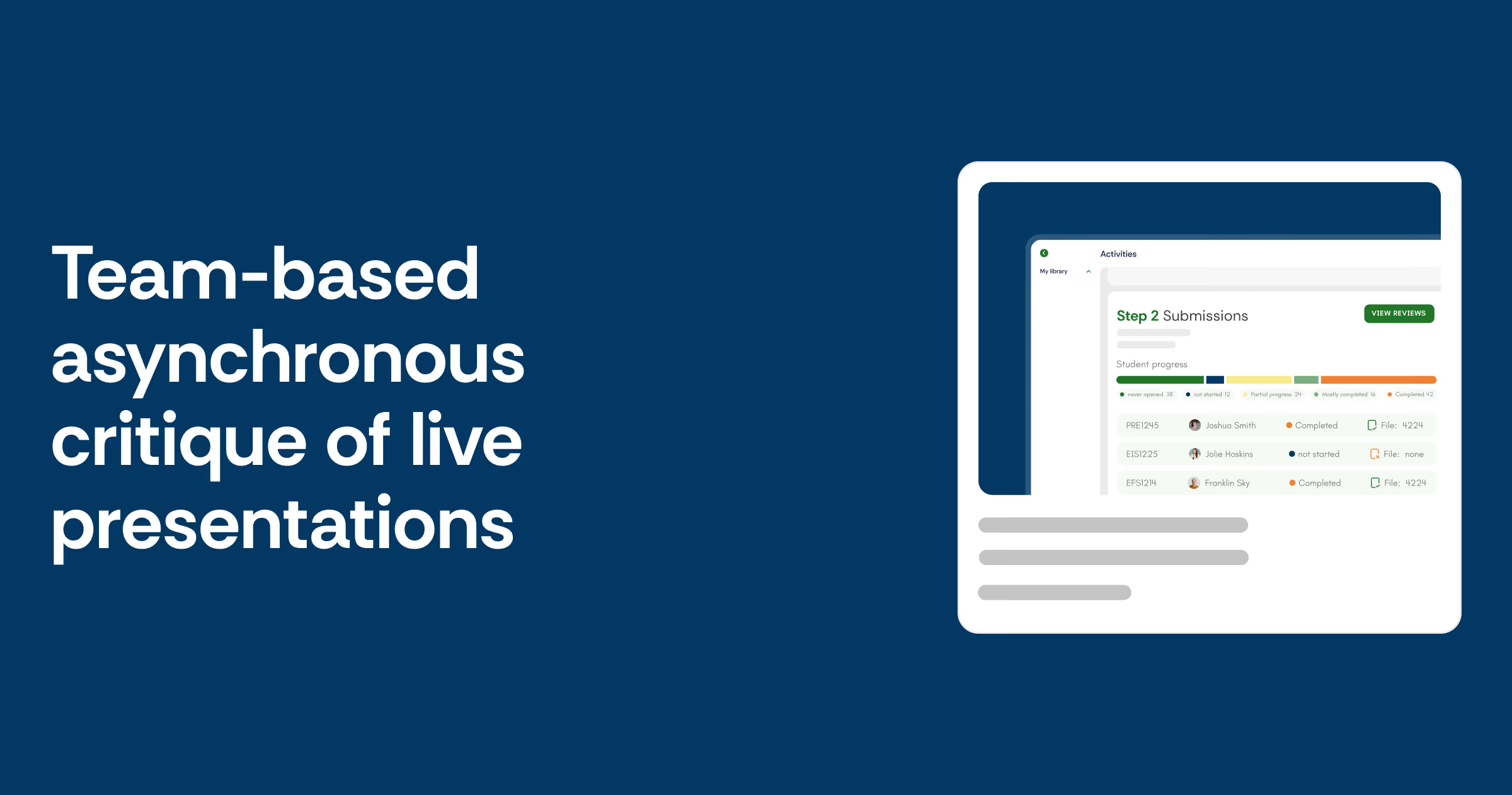
Max Chao extended the critique to every team. Once a team has presented its case and another team has given a live critique, all the remaining teams submit their own critique in FeedbackFruits after class.
Each team uses a shared rubric to assess the content of the presentation, the delivery and the overall impression, and submits one score with constructive comments on behalf of the whole group. Reviewer anonymity is switched on, so presenting teams receive honest feedback without knowing which team wrote it.
Writing the critique asks teams to show their own understanding of the case, which links directly to the main goal of the assignment: identifying the facts and analysing the principles that apply. Teams are graded on the quality and completion of their critique, so careful listening becomes part of the assessment.
What changed
With this design, every team plays an active role in every presentation, moving from watching to assessing, and presenting teams receive structured feedback from the whole class instead of from a single team.

Try it yourself
Use this design in your own course
Max's learning activity is published as a template in the Learning Design Community, so you can explore it, download it and adapt it for your own students.
Try the templateWant advice on how to implement this in your own course?
We'd love to help you think it through.
Book a demoWe'd love to help you think it through.
Continue the story


Join us at InspirED
InspirED 2026 is the LDC Awards ceremony. Celebrate the winners with us on 3 December, in Brisbane or online.
What could this mean for
your institution?
Every winning design began with an educator who wanted something better for their students. If you would like to explore how the Learning Design System could help your institution design better teaching and build evidence of true learning, we would love to talk with you.
Book a demo
