Feedback and assessment innovation
Regional winner Europe
Group Member Evaluation of teamwork and communication skills
How Stuart Scott at the University of Bath helps design students become better collaborators, with regular peer evaluation built into their projects.

Stuart Scott
University of Bath
This template was co-created with Jon Noble.
The challenge
Team working sat at the heart of the unit learning outcomes in these design projects, yet it was hard to show how well students actually worked together. Peer assessment was mostly a way to divide marks, and without a clear view of group dynamics, staff and students often noticed participation problems too late to act on them.
The redesign
Stuart Scott built Group Member Evaluation into design project units across Year 2, Year 3 and the MSc. Each project has its own set up and rhythm, from a shorter project in Year 2 to a longer one in Year 3, with a clear split between formative and summative moments in the MSc.
Students evaluate their group members regularly throughout each project, and written feedback is required alongside every rating. A Feedback on Feedback step asks them to reflect on the quality and impact of what they received. Early formative rounds let students speak freely, because their comments do not yet affect grades, while the later summative rounds carry more weight.
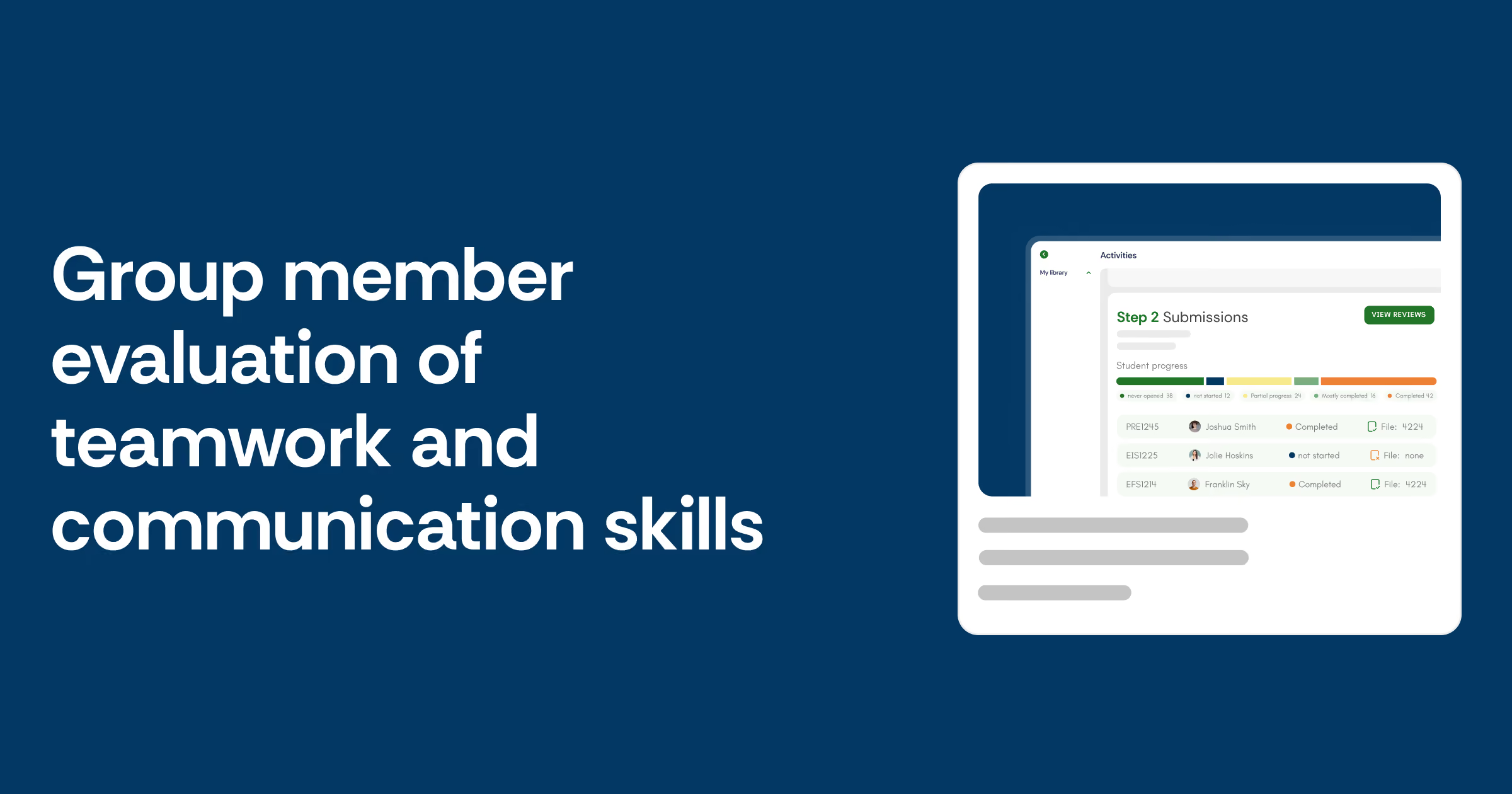
Rather than a standalone marking tool, the evaluations became one piece of evidence in a wider process that students manage themselves when a group runs into trouble. The teaching team could compare how students rated themselves with how their group rated them, which showed whether a problem was individual or shared and made supportive conversations much easier.
What changed
Many groups now use peer evaluation constructively, and students understand better why it matters for their own contribution and for the whole team. The team keeps refining the design, and has already simplified the rubric based on student feedback.

Try it yourself
Use this design in your own course
Stuart's learning activity is published as a template in the Learning Design Community, so you can explore it, download it and adapt it for your own students.
Try the templateWant advice on how to implement this in your own course?
We'd love to help you think it through.
Book a demoWe'd love to help you think it through.

Continue the story

Read the Impact Report
This story shows one course. Our Partner Impact Report shows what learning design made possible across 200+ institutions.

Join the Global Online Awards Ceremony
Register to watch the live reveal of the three global Learning Design Community Awards winners, streamed live from InspirED on Dec 3rd.
What could this mean for
your institution?
Every winning design began with an educator who wanted something better for their students. If you would like to explore how the Learning Design System could help your institution design better teaching and build evidence of true learning, we would love to talk with you.
Book a demo
