
Digitally transforming a 150-year-old institution: How the American University of Greece is embedding active learning at scale


Founded in 1875 and celebrating its 150th anniversary in 2025, the American College of Greece (ACG), now operating as the American University of Greece (AUG), is one of the leading higher education institutions in Greece. With approximately 5,500 students across undergraduate and graduate programs, AUG also extends its reach through a growing portfolio of online offerings via the AUG Global Campus initiative.
Dr. Konstantinos Samiotis is the Director of the Online Education Hub at the American University of Greece (AUG), where he leads the design and implementation of scalable, technology-enhanced learning systems. He is responsible for building a coherent online education ecosystem, including frameworks for program development, quality assurance, and continuous improvement aligned with institutional strategy.
With a background in online education and leadership development, he focuses on enabling faculty and stakeholders to effectively adopt digital tools, translating innovation into improved teaching and learning outcomes.
The Online Education Hub (OEHb is the central unit responsible for designing, supporting, and ensuring the quality of online and technology-enhanced learning at AUG. It provides instructional design expertise, faculty training, and standardized frameworks for course development, helping translate institutional strategy into high-quality, scalable learning experiences.
Founded in 1875 and celebrating its 150th anniversary in 2025, the American College of Greece (ACG), now operating as the American University of Greece (AUG), is one of the leading higher education institutions in Greece. With approximately 5,500 students across undergraduate and graduate programs, AUG also extends its reach through a growing portfolio of online offerings via the AUG Global Campus initiative.
Dr. Konstantinos Samiotis is the Director of the Online Education Hub at the American University of Greece (AUG), where he leads the design and implementation of scalable, technology-enhanced learning systems. He is responsible for building a coherent online education ecosystem, including frameworks for program development, quality assurance, and continuous improvement aligned with institutional strategy.
With a background in online education and leadership development, he focuses on enabling faculty and stakeholders to effectively adopt digital tools, translating innovation into improved teaching and learning outcomes.
The Online Education Hub (OEHb is the central unit responsible for designing, supporting, and ensuring the quality of online and technology-enhanced learning at AUG. It provides instructional design expertise, faculty training, and standardized frameworks for course development, helping translate institutional strategy into high-quality, scalable learning experiences.
Context
Introduction
When Dr. Konstantinos Samiotis joined the American College of Greece (ACG), he took on the responsibility of evolving the Online Education Hub to support a more engaging, student-centered learning experience while empowering faculty to confidently teach and innovate in an increasingly digital environment.
At the same time, ACG, through the American University of Greece (AUG), had launched the Global Campus, a major initiative to expand its online footprint and deliver fully asynchronous programs to a global audience. This shift required tools and practices capable of supporting high-quality learning across modalities and at scale.
AUG began embracing FeedbackFruits through the Alba Online MBA, the College’s first fully online program, now enrolling approximately 140 students. As all online programs, It’s learning and teaching approach is shaped by AUG’s Online Education Hub practices. Building on this foundation, ACG has gradually adopted FeedbackFruits tools in the design of Global Campus online programs and courses, supporting more interactive, engaging, and scalable learning experiences across the institution.


Assessment of learning outcomes
The challenge
AUG's ambition to become a digitally native institution was running into practical obstacles on two fronts: the student experience, and faculty adoption.
On the student side, the missing ingredient was structured active engagement. Students were consuming content passively, with limited opportunities for peer interaction or applied practice. Where feedback existed, it was delayed: existing tools like VoiceThread required instructors to respond to submissions manually and rebuild activities from scratch every term, creating more work for faculty and delivering less for students.
On the faculty side, adoption of digital tools remained low compared to global standards and traditional training sessions were not moving the needle. With 5,500 students and hundreds of courses per year, the team needed tools convenient enough for faculty to genuinely embrace and scalable enough to be embedded into course design from the start.
"We thought that [FeedbackFruits] would enhance the learning experience of our students both in the campus-based and online courses. But at the same time… will help our faculty also get on the bandwagon of technology-enhanced learning
Dr. Konstantinos Samiotis, Director, Online Education Hub
Implementation & activity design
AUG's approach to implementation centres on course production as a collaborative process. Konstantinos and the instructional design team work closely with subject matter experts and faculty to design courses from the ground up, with FeedbackFruits activities built in from the start rather than added later. This means faculty are involved in shaping how the tools are used in their courses, and the activities are ready to go the moment a course goes live.
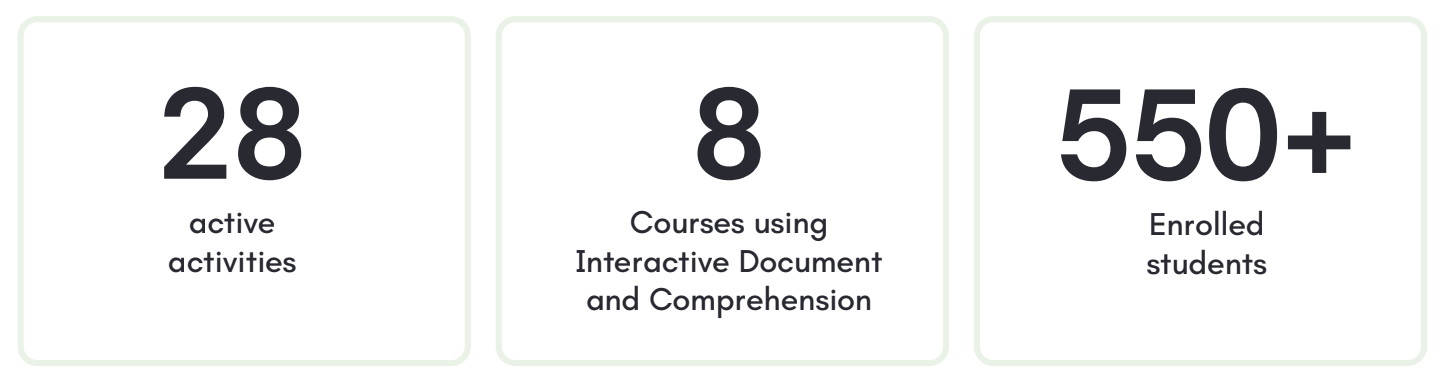
The results of this approach are already visible in the numbers. By late 2025, AUG had 28 active activities using FeedbackFruits Interactive Document and Comprehension running across 8 course, with over 550 enrolled students.
" We are actively preparing and building with FeedbackFruits, and there’s a strong sense of enthusiasm around it within our team. Throughout our course production process, we continuously refine and adapt its use to meet evolving needs—often on a weekly basis.”"
Vasileios Karamanis, Instructional Designer
The following activities illustrate how AUG's team has been using FeedbackFruits across a range of courses and pedagogical contexts.
Activity 1: Article & reading discussions
Learning activity
Interactive Document
Objective
Deepen comprehension of assigned readings through structured discussion and personal reflection
Activity design
Vasileios and his colleagues share an article or a section of a reading directly within the Interactive Document. Alongside the content, they embed a mix of open and closed comprehension questions and reflection prompts, asking students to engage with specific arguments, analyze the material, and share their own perspectives or experiences in relation to the text.
Results:
- Students engage actively with assigned readings rather than consuming them passively
- Reflection prompts support deeper processing of course material and encourage students to connect theory to their own experience
See it in practice: Vasileios Karamanis contributed a template to the FeedbackFruits Learning Design Community - a free, open library of educator-created learning activity templates that puts this approach directly into practice.
Exploring technology-enhanced learning through Interactive Document uses a scenario-based consulting format to help students explore active learning principles and reflect on how technology-enhanced teaching could improve their own practice. Just as AUG uses the Interactive Document to layer comprehension questions and reflection prompts over course content, this template models the same structure around a relatable teaching scenario.
How it works:
- Students read activity guidelines and learning objectives
- They open the Interactive Document and work through multiple-choice questions about the teaching approach of a hypothetical colleague, "Professor Garcia", applying active learning and technology-enhanced teaching principles
- A final reflection step asks students to consider how the principles they explored could be applied to improve their own teaching practice
Take a closer look at our learning activity
Activity 2: Scenario-based learning
Learning activity
Interactive Document
Objective
Build real-world decision-making skills through immersive, consequence-driven scenarios
Activity design
The team builds custom scenarios from scratch using PowerPoint or PDF files uploaded into the Interactive Document. Students are placed in a role, for example as a consultant navigating a professional dilemma, and presented with multiple-choice decisions. Rather than marking answers as simply right or wrong, the activity uses an "action and reaction" model: students see the consequence of their choice before being prompted to reflect. Reflection prompts are embedded after every few questions to help students digest what they have experienced and consolidate their learning.
"We intentionally avoid framing decisions as simply right or wrong, because real-life situations are rarely that clear-cut. Instead, we follow an action–reaction approach: learners make a choice, observe its consequences, and receive feedback. This process helps them understand not just what works, but why."
Ioulita Angelopoulou, Instructional Designer
Results:
- Students engage with material at a deeper level through applied, realistic problem-solving
- The reflective structure encourages students to pause, process, and articulate their thinking supporting transfer of learning
See it in practice: Ioulita Angelopoulou also contributed two templates to the FeedbackFruits Learning Design Community, both built around this scenario-based approach using the Interactive Document:
Stepping into a manager’s shoes with Interactive Document places students in a manager’s role across five real-world decision-making scenarios, asking them to identify decision types, justify their reasoning, and reflect on how uncertainty shaped their choices. It is a direct example of the action-and-reaction format AUG applies in its own scenario-based activities.
How it works:
- Students read the activity instructions, which walk through different decision types and conditions
- They work through five scenarios with embedded questions, locked sequentially so each must be completed before moving on
- Once submitted, students see peers’ answers anonymously and reflect on the group’s responses
Take a closer look at our learning activity
Activity 3: Video annotation
Learning activity
Comprehension Tool
Objective
Transform passive video watching into an active analytical exercise
Activity design
The team uses the Comprehension tool to layer active tasks onto video content. Rather than simply watching a lecture or expert talk, students are asked to annotate specific moments identifying key arguments, evaluating advantages and disadvantages, flagging important concepts, or responding to questions tied to particular timestamps. The exact annotation prompts are designed around the learning goal of each specific activity.
"While videos are inherently engaging, they can still be a passive experience. To address this, we ask students to actively engage by annotating specific elements (highlighting key arguments, evaluating advantages and disadvantages, or identifying important concepts) depending on the learning objectives of each activity."
Ioulita Angelopoulou, Instructional Designer
Activity 4: Group project collaboration space (Online MBA)
Learning activity
Interactive Document, Group Formation
Objective
Support structured, collaborative group project work in a fully asynchronous online MBA program
Program
Fully online, asynchronous MBA - 100+ students per term
Modality
100% online, asynchronous
Activity design
AUG’s online MBA is a fully asynchronous program - one of relatively few of its kind in Europe - designed for working professionals who need to balance study with careers. The program runs over seven weeks, with students assessed through a group project that begins on day one. Sustaining meaningful collaboration between students who never meet in person, across different time zones and schedules, is one of the defining challenges of this format.
To address this, the team used the Interactive Document as a shared, private group workspace. The assignment brief was embedded directly into the document, divided into weekly steps, and groups worked within it throughout the course. Students highlighted sections of the brief, shared ideas as discussion comments, uploaded documents, and replied to each other’s contributions - using the tool for both idea generation and task prioritization. Group Formation was used to organize students into teams, and peer evaluation supported structured end-of-project team reflection.
" Given that we currently work with two core tools, we’re constantly exploring creative ways to apply them. In this case, we used the Interactive Document as a collaborative workspace for a group project. Students engaged through discussions and replies, and in many instances, they expressed how valuable it was to have a shared space that supported their teamwork."
Vasileios Karamanis, Instructional Designer
Results:
- Asynchronous student teams had a structured, centralized workspace that kept collaboration visible and on track without requiring synchronous meetings
- Groups that actively used the tool showed notably tighter grade clustering (see Outcomes section), suggesting stronger team alignment and accountability
- Demonstrated that FeedbackFruits can support the full complexity of online, asynchronous group work, not just individual learning activities
Activity 5: Refreshing course material engagement
Learning activity
Interactive Document (replacing VoiceThread)
Objective
Replace time-consuming, inflexible legacy activities with reusable, automatically-graded alternatives
Activity design
One instructor had been posing questions around course materials, but the workflow was cumbersome: submissions required manual responses and the activity had to be rebuilt from scratch each term.
Migrating into the Interactive Document allowed the team to embed multiple-choice and open-ended questions with automatic feedback, including suggested answers for open-ended responses. Existing presentations and slides from the previous tool were repurposed directly as document content.
"We moved away from a process that relied heavily on manual responses and rebuilt the activity in a way that is both scalable and sustainable. Students now receive immediate, structured feedback, and faculty can easily reuse and adapt the activity across terms."
Lara Bachmann - Tampouratzis, Instructional Designer
Results:
- Students receive immediate, structured feedback rather than waiting for instructor responses
- Faculty can create templates and reuse activities across terms, saving significant time
- Student response was immediate: those who experienced the activity asked why similar tools were not being used in their other courses
Notable outcomes
Outcomes & impact
AUG's instructional design team has already observed meaningful patterns particularly from the MBA group project use case, where grade data was available for comparison.
Student performance
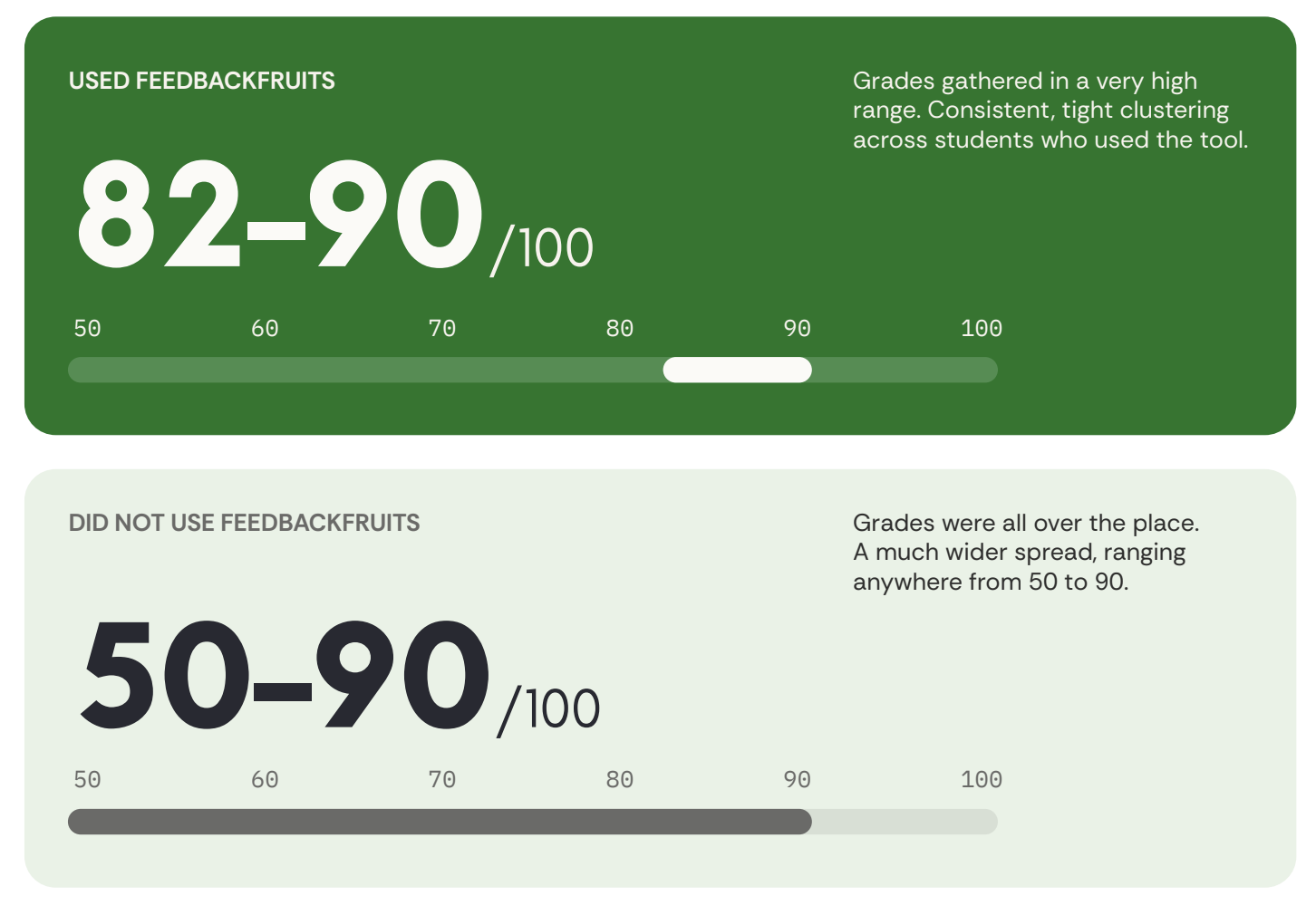
Konstantinos and his team compared the grades of student groups that used FeedbackFruits against those who chose not to. The results were striking: students who used the tools scored consistently between 82 and 90 out of 100, while non-users showed a much wider spread, ranging anywhere from 50 to 90.
According to Konstantinos, the grades of students who used FeedbackFruits were gathered in a very high range, between 82 and 90 out of 100, while those who did not were all over the place. His conclusion: the use of such a tool can really secure student performance, by tightening the relationships between team members and ensuring that everybody knows what the others are doing.
Dr. Konstantinos Samiotis, Director, Online Education Hub
Faculty confidence & efficiency
Beyond student performance, FeedbackFruits has provided faculty with something equally valuable: confidence. Instructors now have visibility into what students are engaging with and how, and the template reusability feature means activities built once can be deployed across terms without rebuilding.
"Instead of a faculty member not knowing what students are doing, he now has some confidence that he has implemented a tool that students can actually take advantage of and keep track of their progress."
Dr. Konstantinos Samiotis, Director, Online Education Hub
Student engagement signals
The impact on student motivation has also come through organically. Following the VoiceThread migration, students who encountered the new Interactive Document activities in one course asked why the same approach was not being used elsewhere.
"We have testimonials from students that they saw this activity in a course, and they were wondering why you don’t make it to other courses as well. This is maybe an indication that students are more engaged, more motivated."
Lara Bachmann - Tampouratzis, Instructional Designer
Possible variation
Scaling up: What comes next
What started as a focused implementation across 10 courses has grown into a full-scale rollout. As it grows, the team is taking a considered approach to activity structure: some are graded and compulsory, others optional. Early evidence already shows that even optional use drives stronger outcomes, and AUG is now in a position to use that data to inform the next phase of design.
The collaboration has been a two-way street. AUG’s team has contributed feedback on tool functionality and three team members contributed templates to the FeedbackFruits Learning Design Community as part of the inaugural LDC Awards. All four are freely available at feedbackfruits.com/learning-design-community-ldc.
A partnership built for the long term
The American University of Greece's story is one of a historic institution choosing to evolve, and doing so thoughtfully. Rather than chasing wholesale transformation, Konstantinos and his team have taken a deliberate, production-first, built-by-design approach: embedding FeedbackFruits into the fabric of course design before courses go live, building a pipeline of activities that will grow with the institution, and letting early evidence make the case to faculty who are yet to be convinced.
At FeedbackFruits, we are proud to be part of AUG's journey toward becoming a truly digitally native institution, one that honors 150 years of educational heritage while preparing its students, and its faculty, for what comes next.



.avif)
.avif)


