
Oral assessment in higher education: The trusted way to see real understanding

The way we check what students actually know is being rethought across higher education right now, and oral assessment keeps coming up as the answer. Before you dive into the how, it helps to see the bigger picture. Here is where the format comes from, what the evidence says about it, and why the timing has finally shifted in its favour.
For a long time, a written essay was a reasonable stand-in for what a student actually knew. You read the work, you judged the thinking behind it, and you trusted that the two were connected. That connection is now harder to take for granted. Generative AI can produce a polished, well-argued, correctly cited essay in seconds, which means a strong submission no longer proves that strong understanding sits behind it.
This is why so many educators are looking again at a very old idea. When you ask a student to explain their reasoning out loud, respond to a follow-up question, and defend a claim in real time, you see something a written artifact can no longer guarantee. You see whether they actually understand. Oral assessment in higher education has moved from a niche tradition to one of the most talked-about answers to the question every teaching team is now asking, which is how we assess real learning when the finished product can be generated by a machine.
This guide explains what oral assessment is, why the research treats it as one of the clearest windows into genuine understanding, and why the moment has finally arrived for it to work at any class size rather than only in small seminars.
What is oral assessment?
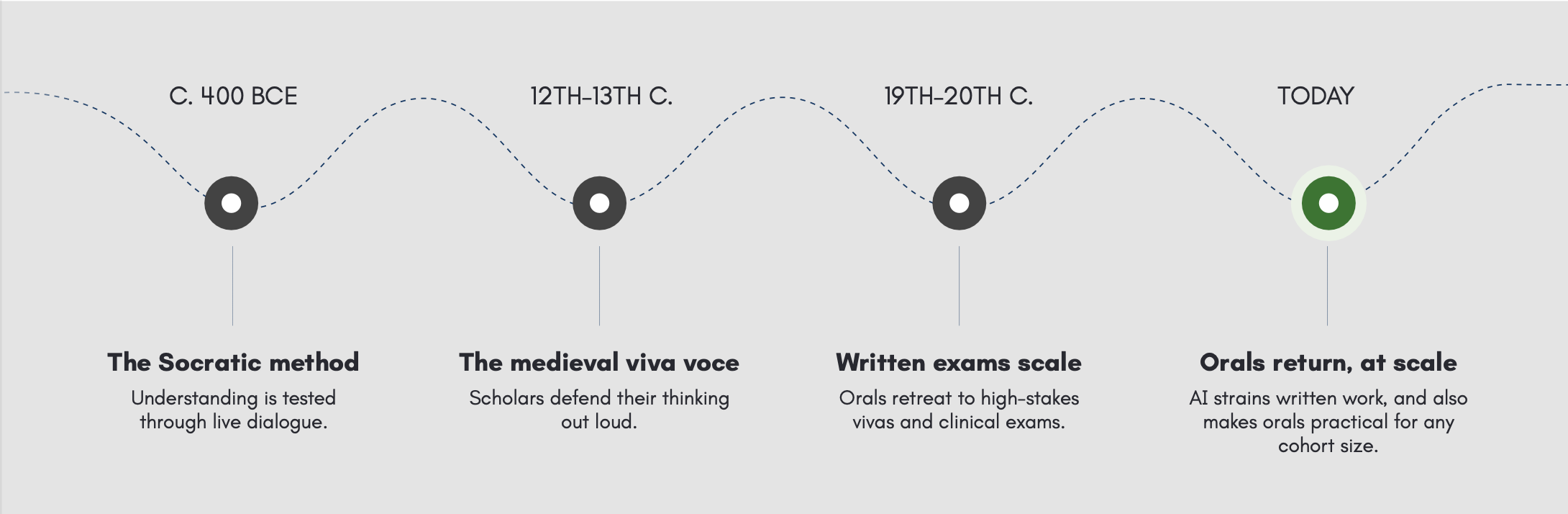
Oral assessment is any assessment where a student demonstrates their learning by speaking. Instead of handing in a document and waiting for a grade, the student talks through their reasoning, answers questions, and shows their thinking as it happens. The format is sometimes called viva voce, which is Latin for living voice, and it has a long history. Universities have used spoken examinations since the medieval period, and the modern doctoral defence is a direct descendant of that tradition.
The format is more flexible than the word examination suggests. An oral assessment can be a short structured interview about a project, a professional conversation that mirrors a real workplace situation, a reflective discussion about how a student approached a task, or a viva that probes the depth of understanding behind a written submission. A useful way to think about it, borrowed from recent research, is as an evaluative conversation between the assessor and the student, rather than an interrogation. The point is not to catch the student out. The point is to let them show what they know in a way that is difficult to fake.
Why oral assessment shows real understanding
The case for oral assessment is not based on intuition alone. It is one of the better-studied assessment formats in higher education, and the findings are consistent.
A 2024 systematic review published in Issues in Educational Research examined the validity, reliability, and integrity of oral assessments across a large body of studies. It found that oral formats are well suited to assessing deep understanding, the application of theory to practice, and problem-solving, because a student has to reason in the moment rather than reproduce something they prepared in advance. Earlier work reached the same conclusion, finding the viva a valid way to assess deep learning and the application of theory to practice. The same review noted that oral assessment tends to support weaker students in particular, with several studies reporting improved grades overall, because the format gives students a chance to clarify their thinking rather than lose marks to a single ambiguous written answer.
Reliability is often the first worry people raise, since a conversation can feel more subjective than a marked script. The evidence points to a clear answer, which is that structure is what makes the difference. When oral assessments are built around a shared rubric and consistent questions, their reliability is high, with studies reporting internal consistency in the region of 0.75 to 0.80, compared with around 0.50 for unstructured formats. In other words, a well-designed oral assessment rubric turns a conversation into a fair and repeatable judgment. This is why the rubric matters so much, and why it sits at the centre of how we think about oral assessment.
The benefits of oral assessment
The value of oral assessment shows up differently for each group involved, and it is worth being explicit about all three.
For students, an oral assessment rewards understanding rather than presentation. A student who truly grasps the material can explain it, adapt it to a new question, and think on their feet, and the format gives them room to demonstrate exactly that. Articulating your reasoning out loud is also a form of deeper learning in itself, because the act of explaining forces you to organise and test your own thinking.
For educators, oral assessment restores confidence in the grade. You are no longer marking a document and hoping it reflects the student in front of you. You are hearing the understanding directly, which is a far more trustworthy basis for a judgment.
For institutions, oral assessment offers a secure and authentic way to protect academic integrity without treating students as suspects. It measures the kind of real-time thinking, communication, and professional judgment that employers actually value, which makes it authentic in the truest sense of the word.
Authentic assessment in the age of AI
The phrase authentic assessment describes tasks that resemble the real problems a student will meet in their working life, rather than artificial exercises that exist only to be graded. Oral assessment fits this definition naturally, because so much professional work happens through conversation. A nurse explains a treatment plan, a consultant defends a recommendation, an engineer talks a client through a design decision. Assessing a student through a spoken exchange mirrors the situations they will face after they graduate.
This is also what makes oral assessment resilient in the age of AI. A generative model can write a flawless essay, but it cannot sit in the room and think alongside the student, and it cannot answer an unexpected follow-up question in the student's own voice with the student's own understanding. The value of an oral assessment does not depend on locking down technology or policing what tools a student used at home. It depends on a simple fact that no model can get around, which is that understanding has to live in the person who is speaking.
For a fuller look at why detection software is no longer a dependable answer to AI in student work, and what a defensible alternative looks like, see our piece on AI detection alternatives for higher education.
The old problem, and why it is finally solved
If oral assessment is this strong, a fair question follows. Why did it ever fall out of favour? The honest answer is not that it stopped working. It is that it stopped being practical. Oral assessment is time-intensive, and that cost rises directly with the size of the class.
The numbers make the ceiling clear. A twenty-five minute oral for a class of thirty-six students, with two graders, adds up to around thirty hours of faculty time, which is feasible for a small cohort and genuinely difficult once you reach a hundred students or more. For most large courses, that workload put oral assessment out of reach, and written work became the default not because it was better, but because it was manageable.
This is the part of the story that has changed. AI support now removes the workload ceiling that kept oral assessment small. A well-designed platform can handle the parts that never needed human judgment, such as scheduling, running a consistent set of questions, and preparing a first-pass evaluation against your rubric, while the academic judgment stays firmly with the teacher. That combination is what finally makes oral assessment realistic at scale. We explore exactly how this works, with the workload maths, in our guide to running oral assessment at scale.
Bringing oral assessment into your courses
Oral assessment is no longer a trade-off between quality and practicality. It is one of the most trustworthy ways to see genuine understanding, and for the first time it works at any cohort size.
At FeedbackFruits, we have built a connected set of tools to make this practical inside the LMS your teachers already use. Oral Assessment lets you run rubric-based spoken assessments at scale, with AI handling the routine work and educators keeping full control of the grade. Oral Practice gives students a safe, low-stakes space to rehearse and build confidence before anything counts. Oral Reflection helps students think out loud about how they learned, which deepens understanding in its own right.
If you want the full picture of how orals scale without adding hours to your teachers' weeks, our free ebook on oral assessment at scale lays it all out. And when you are ready to try it with your own courses, you can get started with oral assessment and practice here.


![[New] Competency-Based Assessment](https://no-cache.hubspot.com/cta/default/3782716/interactive-146849337207.png)


.png)

.avif)


