Inside our Partner Impact Report 2025/26: quality teaching at scale


How do you know your students are truly learning, now that AI can write the essay for them? Our Partner Impact Report 2025/26 follows our partner institutions through a full academic year to answer that question with evidence. In this article, we explain what the report covers, how we measured impact with a logic model, which numbers stood out for us and why we look at students, educators and institutions together.
What the Partner Impact Report is about
During the 2025/26 academic year, a finished assignment started to tell us less about what a student has learned. The real evidence moved into the learning process itself: the first attempt, the feedback that follows and the revisions students make themselves. At FeedbackFruits, our answer to AI is a pedagogical one, which means making that process visible for students, educators and institutions while the course is still running.
The report shows how our partners did this with the Learning Design System, right inside the LMS they already use, and what it made possible for their students. It covers 33K+ educators, 1M+ students and 200+ partner institutions in 28 countries, using aggregated and anonymised data from September 2025 to August 2026. Every figure counts what students and educators actually did inside learning activities, such as starting, completing or reviewing them, rather than logins or accounts created.
How we measured impact with a logic model
To keep our story honest and easy to follow, the report is built on a logic model. A logic model is a simple way of showing how a programme is meant to work: it traces the path from what we provide, to who uses it and how, to what that use produces, and finally to what changes in the end. The approach comes from the W.K. Kellogg Foundation's Logic Model Development Guide, and it also sits behind the fourth tier of evidence in US education policy.
- Inputs: the Learning Design System and its teaching solutions.
- Participants: the educators, students and institutions who use it.
- Activities: how they used it, from the designs educators built to the learning tools students started most.
- Outputs: the measurable results, such as completed activities and peer feedback.
- Outcomes: the impact we are committed to and working towards with our partners.
Inputs, activities and outputs are measured, while outcomes describe the impact we expect, and the report is open about where the evidence is still emerging.
The numbers that stood out for us
- 80% of started learning activities get completed, so 4 in 5 activities designed for active learning are seen through to the end.
- 86% of activities are built from a proven design, which means educators reuse what works instead of starting from a blank page.
- Over 4M pieces of feedback were written by students to each other, and students rated the feedback they received 9/10 for usefulness.
- 4.7M questions were answered inside videos and readings.
- 60% of partners doubled their reach by year three, as proven designs reach more students within each institution.
The number we are proudest of is the feedback, because each of those 4M+ reviews was written by one student for another, in a year when the easiest thing in the world was to ask an AI model to write it instead.
Why we look at impact for students, educators and institutions
Real change in teaching never happens at one level only. A student who is asked to take a more active role in their learning needs an educator who can design for it, and that educator needs an institution where effective practice can move beyond a single course. That is why the report follows all three groups, and why our impact commitment describes what we are working towards for each of them in the short, mid and long term.
Short term: first evidence
- Students engage more deeply and receive feedback that drives learning.
- Educators put proven learning designs into action with low effort.
- Institutions have proven learning designs in use across courses.
Mid term: repeated impact
- Students build critical thinking, collaboration and feedback literacy.
- Educators reuse proven learning designs that keep student thinking active.
- Institutions see true learning become consistent across programmes.
Long term: sustained impact
- Students graduate with evidenced skills relevant to workforce readiness.
- Educators sustain effective teaching that makes students' thinking and development visible.
- Institutions see stronger student progression and retention.
Not every stage can be measured in the same way yet, so the report clearly separates what we can already observe from the impact we are still working with our partners to make visible.
Proof from our partners
The numbers come to life in the stories of our partners. Here are a few examples from the report:
- At Hertfordshire Business School, the typical student in a fully online MBA module went from three interactions to ten, and overall participation rose sixfold.
- At Falmouth University, reusable templates cut assessment setup time fourfold for more than 300 students a term working in multidisciplinary teams.
- At the University of Bath, the Faculty of Engineering and Design adopted FeedbackFruits across all four of its departments after staff and students rated it positively.
- At EDHEC Business School, one round of peer review in a group of 30 students produced more than 360 peer responses, and the design now runs in a course of 800 students.
- At the University of Arizona, what started in 2023 as a nine month pilot, judged by a student advisory board against Quality Matters standards, now runs across the university.
A word from Ewoud and Franziska
The report opens with a word from our Founder and CEO, Ewoud de Kok, and our VP of Trust, Franziska Böhler. Ewoud explains why our answer to AI is a pedagogical one: rather than detection or surveillance, it is better teaching design made practical for a whole cohort, inside the learning systems educators already work in.
“The numbers in this report are our honest account of how far we have come. Some show real change, some are early signals, and some show where we still have work to do.”
Ewoud de Kok, Founder and CEO of FeedbackFruits
“As VP of Trust, part of my job is to make sure every claim we make about that impact is true to the educators and students behind it. That is why these numbers can only grow when we make meaningful improvements to the learning designs our product supports.”
Franziska Böhler, VP of Trust at FeedbackFruits
Read the full report
The full report goes deeper into the five pressures on teaching quality today, how each teaching solution answers them, which learning tools students used most, and the four steps our partners who got furthest all took. None of them began with an institution wide strategy. They started with one educator, one course and one real problem worth solving.
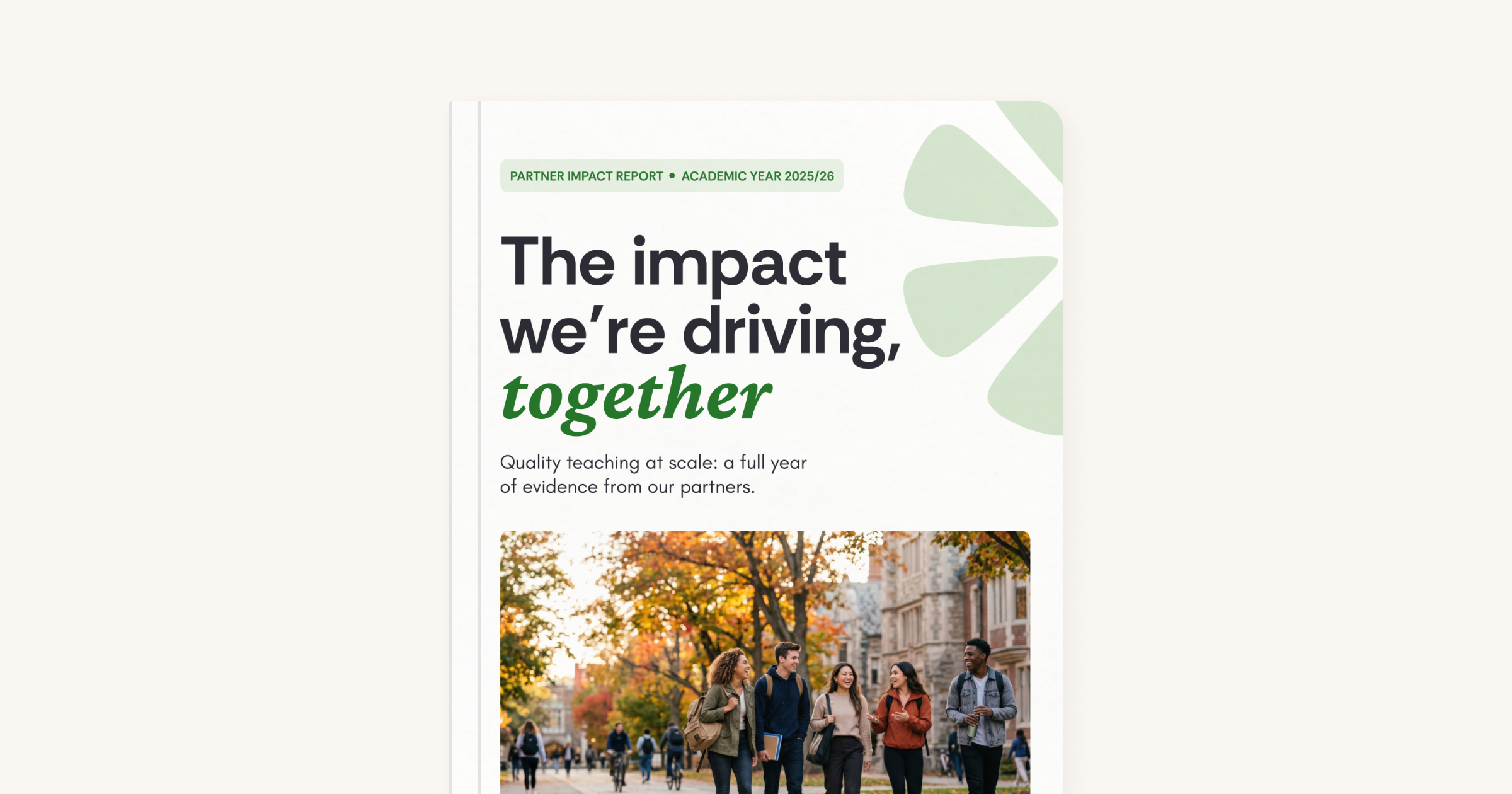
Get the Partner Impact Report 2025/26
The report is also part of our story From course redesign to institutional impact, where you can meet the nine regional winners of the LDC Awards 2026. And if a problem in your own courses came to mind while you were reading, we would love to hear about it.
Book a meeting with our team, and we will look at your courses with you to find where a small first step would make the biggest difference.