Why students skip the reading, and how to design one they finish

Ask faculty in a reading heavy discipline what frustrates them most and you tend to hear the same story. The seminar was built around a text, half the room has not read it, and the session becomes the instructor summarising an article to people who were meant to have summarised it themselves.
The usual explanations point at students. This article points at the assignment instead, sets out the four things that make the traditional version fail, and describes how to design a reading task that a good proportion of the room will actually complete.

Four reasons the usual reading assignment struggles
It has no visible product. Almost every other piece of academic work produces something. Reading produces nothing anyone will see, which means that under time pressure it is always the rational thing to drop. Students are not being lazy when they skip it, they are correctly identifying the task with no consequence.
It gives no direction. An experienced reader in a field knows what to look for in a paper: the claim, the method, the limitation, the thing that connects to last week. A second year student does not, so they read every sentence with equal attention, run out of energy at page four, and retain very little. This is why students often report that they did the reading and still cannot discuss it.
It is solitary. A doctoral student reads alone because they already belong to a community that discusses the text elsewhere. An undergraduate reading alone has no way to find out whether their confusion is normal, and confusion without company usually becomes abandonment.
It offers no feedback. A student who misreads an article discovers this, at best, in a seminar several days later, and more often never. There is no point at which the reading is checked while it is still happening.
Every one of these is a property of the assignment, not of the student.
What changes when reading happens in a shared document
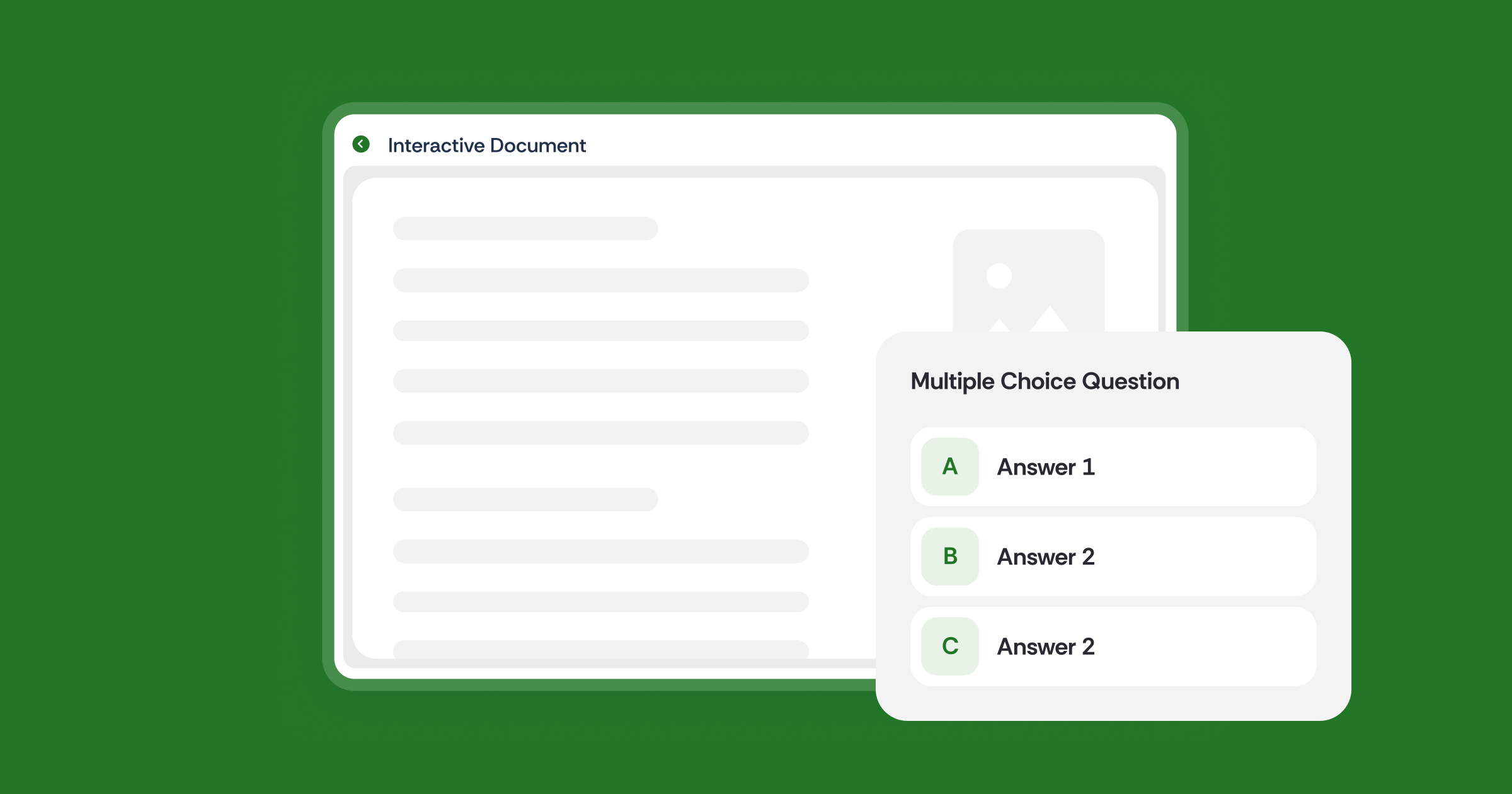
Putting the text into an environment where students annotate it, answer embedded questions and see each other's comments addresses all four problems at once, which is why the effect is larger than any single feature would suggest.
The reading now has a visible product, because annotations and answers exist and the instructor can see them. It has direction, because questions placed at specific points tell students what to attend to. It stops being solitary, because a student who did not understand paragraph nine can see that four classmates also stopped there. And it has feedback, because a misreading becomes visible at the point it happens, either to a peer who responds or to the instructor scanning responses before class.
None of that is about technology being engaging. It is about removing the four specific reasons the old design fails.
How to build one
Choose a shorter text than you think. The most common mistake is to assign the same forty page chapter and add questions to it. Students who did not finish forty pages of plain text will not finish forty pages of annotated text. Cut to the eight or twelve pages that carry the argument, and say explicitly why you chose those pages, because that itself teaches something about reading in your discipline.
Place questions where students get stuck, not at the end. Three to five questions distributed through the text works better than a set of comprehension questions afterwards. Put one early, so the expectation is set within the first page. Put one at the hardest passage. Put one at the point where the text connects to what you taught last week, because students almost never make that link unprompted.
Ask for judgement, not retrieval. "What is the author's main claim" can be answered by copying a sentence. "The author dismisses the alternative explanation in one line on page four. Do you think that is enough? Why?" cannot. Questions that require a position produce responses worth reading and give you something to open the seminar with.
Make at least one prompt collaborative. A discussion prompt where students see and reply to each other turns the reading into a conversation that has already started before the class begins. In large cohorts this is often where the best thinking in the whole course appears, because students who never speak in a room will write at length in the margin.
Ask students to mark what confused them. A prompt that simply invites students to highlight the passage they found hardest, with a sentence about why, takes them two minutes and hands you the most valuable single piece of information you can have before a seminar. Cluster the highlights and you know where to start.
What to do with what comes back
The work only pays off if someone looks before the class. The scan takes ten to fifteen minutes for a large cohort if you know what you are looking for.
Find the passage that attracted the most confusion, and start the seminar there rather than at the beginning. Find two responses that disagree with each other and open by putting both on the screen, without names, and asking the room to adjudicate. Find the misreading that several students share, because that one is worth correcting explicitly. Where an AI assistant can group and surface responses, this becomes a scan rather than a read.
Then tell students that this is where the session came from. The behaviour you want, which is careful reading with honest annotation, only becomes habitual when students see it feeding into what happens in the room.
Grade it lightly, or not at all
There is a strong temptation to grade the annotations, and it usually backfires. Once annotation quality carries marks, students write for the instructor rather than for themselves or each other, and the honest "I have read this three times and I still do not understand what they mean by this" disappears. That sentence is the most useful thing a student can write and it needs to be safe to write.
Completion based credit is the reasonable middle ground. Students get participation credit for engaging with the text, the quality is not marked, and the incentive structure stays pointed at reading rather than at performance. If you want to know more about the grading options, including completion based credit, our Interactive Document FAQ covers them.
What this will not fix
It is worth being clear about the limits. Students who are working thirty hours a week to pay rent will still sometimes not do the reading, and no assignment design changes that. A shared document does not make a badly chosen text worth reading. And the first time you run this, some students will resent it, because a task that used to be invisible is now visible and they preferred it invisible.
The realistic claim is narrower and still worth having. Most students skip the reading because the assignment as traditionally designed gives them almost no reason to do it and almost no help in doing it well. Fix those two things and a substantial proportion of the room arrives having read, with something to say.
Where to go next
If you would like to see how this works inside the tool itself, the Interactive Document solution page shows how texts, embedded questions and student annotations work together. The Interactive Document FAQ is a good next stop if you have the practical questions that usually come up before a first run, such as how the activity sits in your LMS, what students see, and what happens when someone misses a deadline.
It is also worth looking at the tools that sit naturally alongside this one, including Comprehension, Discussion and Interactive Video. You can see how they all fit together on the FeedbackFruits tool suite page, or read more about what a feedback and assessment solution actually is if you are building the case for your institution.
And if you want to keep reading on this topic, we have 8 interactive document examples, Stimulate continuous engagement with Interactive Document and How to engage students with questions: 6 strategies for social annotation.


![[New] Competency-Based Assessment](https://no-cache.hubspot.com/cta/default/3782716/interactive-146849337207.png)


.png)

.png)