
Oral assessment at scale: how to run orals for 100 students without the workload

If you have ever loved the idea of oral exams and then done the maths for a large cohort, you know exactly where the enthusiasm tends to go. This piece is about closing that gap. It looks honestly at why the format became impractical, and at what has changed so that the assessment you trust becomes something you can run across your biggest classes.
There is a common assumption that oral assessment simply does not belong in a large course. You can picture it working beautifully for a final-year seminar of twelve students, and you can just as easily picture it collapsing under the weight of a first-year cohort of three hundred. That assumption is worth examining closely, because it holds a mistake at its centre.
Oral assessment did not fall out of favour because it stopped working. It fell out of favour because it stopped being practical once class sizes grew. Those are very different problems, and only one of them was ever really about the format itself. The good news is that the practical problem, the one that actually pushed orals aside, is the one that current technology now solves. This article is about how oral assessment at scale becomes realistic, what the workload really looks like, and how you keep quality and judgment intact while you grow.
The real reason orals disappeared from large courses
The evidence for oral assessment as a way to measure genuine understanding is strong and long-standing. Research consistently shows that structured oral formats achieve high reliability, and that they are well suited to assessing the kind of deep reasoning and problem-solving that written work can struggle to capture. None of that changes when a class gets bigger. A conversation reveals just as much understanding in a cohort of two hundred as it does in a cohort of twenty.
What changes is the arithmetic. Oral assessment is time-intensive, and the time scales almost linearly with the number of students. This is the ceiling that quietly removed orals from large courses over the past few decades, and it is worth seeing the ceiling clearly rather than guessing at it.
What the workload actually costs
The numbers are more concrete than most people expect. A twenty-five minute oral examination for a class of thirty-six students, evaluated by two graders, comes to roughly thirty hours of faculty or teaching assistant time. For a cohort of thirty-six, that is demanding but feasible, and many programmes run exactly this kind of assessment today. For a cohort of one hundred, the same design becomes very hard to justify, and beyond that point it becomes close to impossible without a dedicated team of trained examiners.
This is the shift worth naming clearly, which is that oral exams were standard right up until the moment they could no longer scale with class sizes, and modern tools are what make them workable again. Faculty who have run orals in large courses describe the same reality, and some have shared practical templates for doing it at scale. The interview phase, which is where nearly all the time goes, is exactly the part that can now be handled differently, so that the hours stop rising with every extra student.
It helps to separate an oral assessment into its parts, because only some of them ever needed a human being.
Scheduling and coordination never needed academic judgment at all. Even a modest cohort of thirty-six generates a surprising tangle of conflicts, from overlapping exams to time zones to family commitments, and coordinating all of it eats hours before a single question is asked. Running a consistent set of questions against a shared rubric is structured and repeatable by design. Preparing a first-pass evaluation, a transcript, and a draft score against that rubric is careful work, but it is not work that has to start from a blank page. What does need a human being is the judgment: reviewing the evidence, weighing the borderline cases, and deciding the grade. That last part is the part you never want to automate, and it is the part that keeps oral assessment trustworthy.
How AI removes the ceiling without removing the teacher
The value of AI support in oral assessment is not that it replaces the examiner. It is that it absorbs the hours that were never the point, so that educator time goes where it belongs.
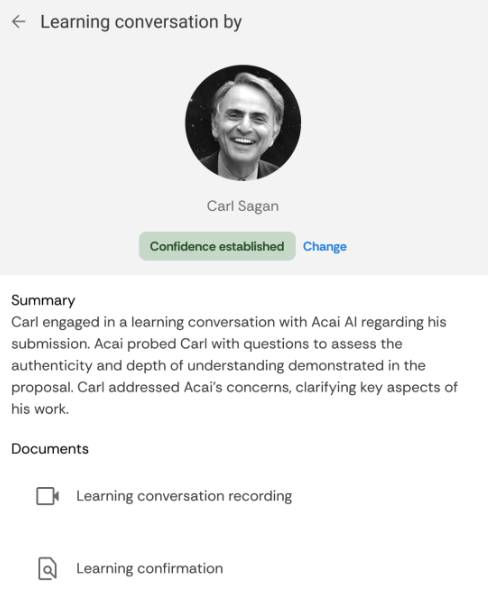
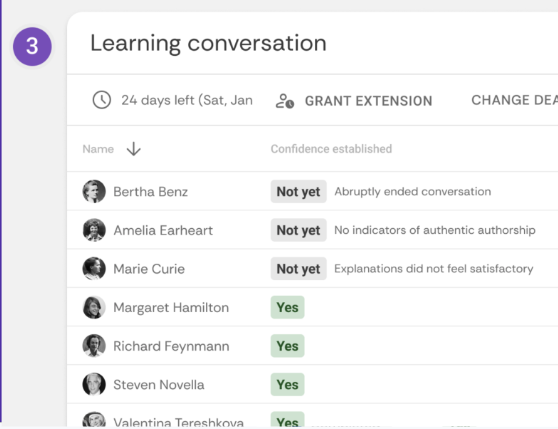
In practice, this means an AI-supported oral assessment can run each student through a consistent, rubric-aligned conversation on a schedule the student chooses, record the exchange, and produce a transcript and a structured first-pass evaluation for the teacher to review. Scheduling stops being a constraint, because students book their own slot inside a window rather than competing for a shared calendar. Consistency improves rather than slips, because a rubric applied the same way to every student does not get tired at the end of a long marking day. The teacher then reviews the output, focuses attention on the cases that need it, and makes the final call.
This is the difference between scaling the workload and scaling the assessment. You are not asking your faculty to find thirty, sixty, or a hundred and thirty hours that do not exist. You are running the same high-quality oral assessment across a large cohort while human judgment stays exactly where it should, on the grade.
There is a second, quieter benefit here. Once the marginal cost of an oral drops, you can use the format far more often. Oral assessment stops being reserved for a single high-stakes moment at the end of term and becomes something you can run as low-stakes practice throughout a course, which no department could ever staff with human examiners. That regular, spoken engagement is good for learning in its own right.
Keeping quality high as you scale
Scaling oral assessment well is mostly about protecting the things that make orals valuable in the first place, and a few principles carry most of the weight.
The rubric is the foundation. A clear, shared, consistent oral assessment rubric is what turns a set of conversations into fair and comparable judgments, and it is what lets an AI-supported first pass be genuinely useful rather than a distraction. Human judgment stays on the decisions that matter, which means educators review, adjust, and own every final grade rather than rubber-stamping a machine output. Practice comes before the stakes, so students should meet the format in a low-pressure setting before it counts, which reduces anxiety and produces a fairer picture of what they know. Sitting the assessment inside your existing LMS keeps the whole thing manageable, because oral assessment LMS integration means teachers and students work in tools they already understand rather than learning a separate system.
Make orals work for your largest cohorts
The old trade-off between the quality of oral assessment and the size of your class no longer holds. You can keep the format that best reveals genuine understanding, and you can run it for a hundred students or more, as long as the routine work is handled for you and the judgment stays with your teachers.
At FeedbackFruits, this is exactly what our Oral Assessment solution is built to do. It runs rubric-based spoken assessments at scale inside your LMS, with AI handling scheduling, consistent questioning, and a first-pass evaluation, while educators keep full control of every grade. Pairing it with Oral Practice lets students rehearse in a safe space first, so the assessment itself is fairer and less stressful.
If you want the complete playbook, including the workload maths and real examples of orals running across large cohorts, our free ebook, Oral Assessment at Scale, covers it in depth. For the wider case on why orals are worth this effort in the first place, start with our pillar guide to oral assessment in higher education. And when you are ready to run it in your own courses, you can get started with oral assessment and practice here.


![[New] Competency-Based Assessment](https://no-cache.hubspot.com/cta/default/3782716/interactive-146849337207.png)


.png)

.avif)


