
Webinar Replay: From isolated rubrics to a shared framework with Charles Drew University


What does it really take to track student skill development across an entire nursing program? Charles Drew University found out and shared every lesson. Watch the replay now.
The challenge
When every faculty member uses a different rubric, who is tracking the student?
Nursing programs across the country are under pressure. Accreditation bodies want evidence. Employers want practice-ready graduates. And students, many of them adult learners balancing jobs and families, want assurance that their degree actually means something.
The problem? Most institutions are still measuring knowledge the old way: one exam, one essay, one course at a time. Skills fall through the cracks. Different faculty members in the same program use different rubrics for the same assignment. And by the time anyone notices a gap in a student's skills, it is often too late to close it.
That was the reality at Charles R. Drew University of Medicine and Science (CDU), until they decided to build something different.
"We had no way to do comparative analysis within a program across degree level, within a college, and especially across colleges within the university as a whole. Everyone had different criteria."
— Dr. William Shay, Sr. Vice Provost, Charles R. Drew University of Medicine and Science
Why it matters now
AI changed what it means to assess a student.
The pressure to rethink assessment is not just about accreditation. Dr. Sheryl Antido, Associate Dean and program director at CDU, put it plainly: when a student can generate a clinical care plan or a written report in seconds with AI, submitting that work is no longer proof they actually understand it.
"Just because you could generate the notes, generate a plan of care, generate a paper, does the student really understand what it means? Submitting a paper right now is no longer a basis for us to determine: yes, you have the knowledge."
— Dr. Sheryl Antido, Associate Dean and Program Director, Charles R. Drew University of Medicine and Science
The webinar surfaces four gaps that CDU identified and that will feel familiar to most program leaders:
- 1 - Over-reliance on AI affecting students' critical thinking;
- 2 - Reduced faculty visibility in online courses;
- 3 - Inconsistent rubrics across the same program;
- 4 - Disconnected assessments that fail to capture whether a student is truly ready to practice.
What they built
One shared framework, woven across every level of the nursing program.
The CDU team did not just adopt a new tool. They redesigned how skill development is tracked across their entire nursing program, from students entering the profession for the first time all the way through to those completing advanced clinical leadership degrees.
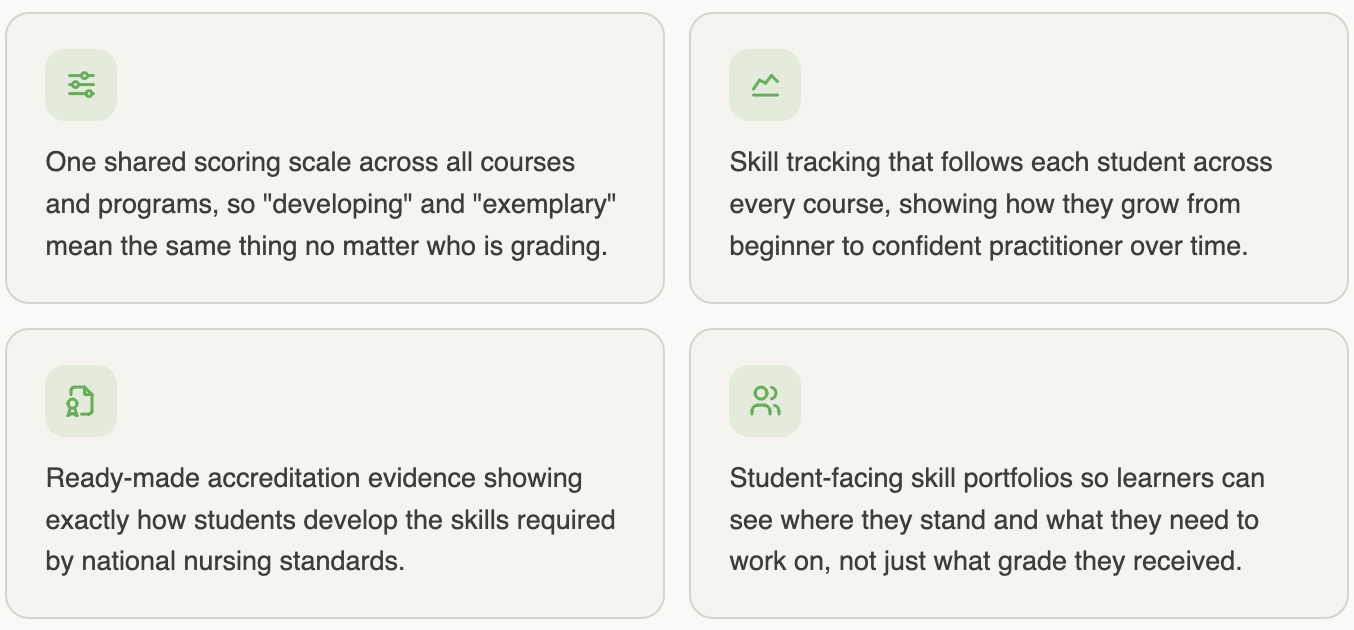
With FeedbackFruits, CDU built one shared scoring scale across all courses and programs, so "developing" and "exemplary" mean the same thing no matter who is grading. Skill tracking follows each student across every course, showing how they grow from beginner to confident practitioner over time.
Faculty can generate ready-made accreditation evidence showing exactly how students develop the skills required by national nursing standards. And students get their own skill portfolios so they can see where they stand, not just what grade they received.
"I do have an accreditation coming in next year. I wanted to make sure I am ready to show proof that yes, we meet standards nationally — because we use a platform that helps us identify what the student needs, what their weakness is, how they progress, and how they get to that goal."\
— Dr. Sheryl Antido, Associate Dean and Program Director, Charles R. Drew University of Medicine and Science
"It is not enough that we get data. What do we do with that data? We brag about the good things, but we really need to look at what else needs to be done."
— Dr. Sheryl Antido, Associate Dean and Program Director, Charles R. Drew University of Medicine and Science
Free resources
Liked what you heard? Take it further with these two.
How to Build Competency Rubrics That Actually Stick: A practical guide to getting your rubric framework off the ground.
Missed something? Here's everything covered in the webinar: The key takeaways and next steps, all in one place.
The replay is available now
Ready to build your own competency backbone?
Watch the full conversation with Dr. Shay and Dr. Antido, including the live Q&A, the CDU pilot breakdown, and actionable steps you can take this semester.
Watch the replay now


![[New] Competency-Based Assessment](https://no-cache.hubspot.com/cta/default/3782716/interactive-146849337207.png)


.png)


.avif)


