
What is Competency-Based Medical Education and why your program can't afford to get it wrong


Time in a classroom was never a guarantee of competence. As accreditation bodies tighten their reporting requirements, programs are forced to confront an uncomfortable truth: observing a student isn't the same as documenting their progress. Here's what getting it right actually looks like.
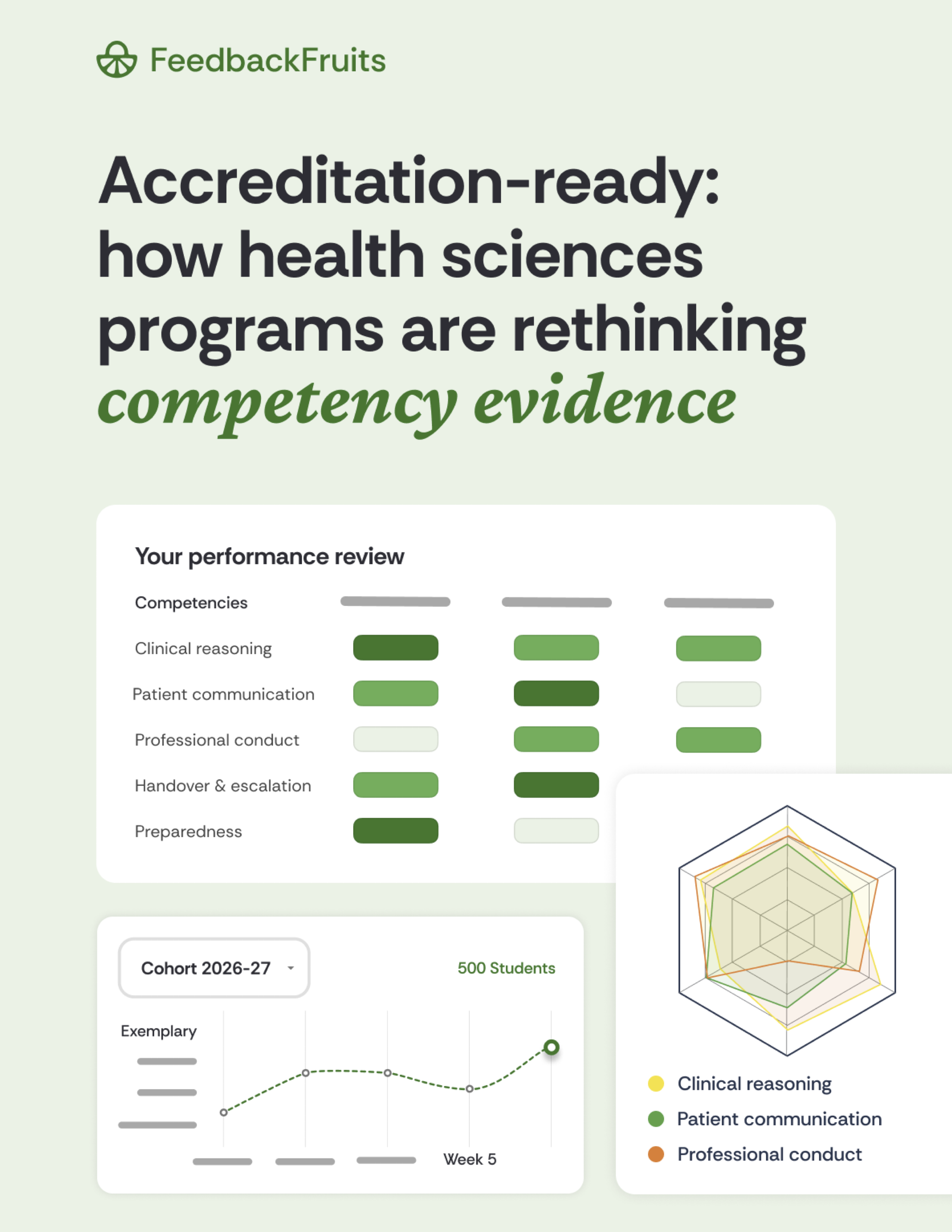
There are two versions of competency-based medical education (CBME). One lives in accreditation documents: milestone tables, six-domain frameworks, glossaries that take twenty minutes to parse. The other plays out in a real clinical corridor, where a supervising physician watches a student struggle to communicate a diagnosis to a patient's family and thinks: how do I know if this student is actually ready?
CBME started as an answer to that second question.
From time-based to evidence-based
For decades, medical education ran on time. Four years of school, residency, the right board exams, and you were deemed a physician. The assumption was that enough hours in the right rooms would produce competent clinicians.
Research in the late 1990s and early 2000s showed it didn't. Patients were being harmed by gaps that standardized training hours had failed to close, and variability between graduates from the same programs was significant. The American Medical Association (AMA) put it plainly: competency-based training means moving away from seat time as a proxy for learning, toward actually establishing that the knowledge and skills required for patient care have been acquired.
In 2026, this has moved from philosophy to obligation. Accreditation bodies in the US, Canada, the UK, and Australia have shifted from aspirational frameworks to concrete reporting requirements and many programs' existing systems simply aren't built to meet them. The FeedbackFruits whitepaper Accreditation-ready: How health sciences programs are rethinking competency evidence maps this regulatory picture across all four regions and is worth reading if you want to understand how this pressure is converging globally.
What it looks like in practice
In graduate medical education, the Accreditation Council for Graduate Medical Education (ACGME) Milestones framework organizes competencies across six domains: patient care, medical knowledge, systems-based practice, practice-based learning and improvement, professionalism, and interpersonal and communication skills. Residents are assessed on a five-level scale from early learner to ready for unsupervised practice.
In nursing, the American Association of Colleges of Nursing (AACN) revised its Essentials in 2021, making competency-based education the organizing principle for all nursing programs. The Accreditation Commission for Education in Nursing (ACEN) followed with updated standards in 2023. Both require documented evidence of student progression across defined domains throughout the full program. The FeedbackFruits pedagogy guide on competency-based learning explains how activities, rubrics, and portfolio evidence connect into a coherent system. If your faculty are newer to the framework, the beginner's guide to competency-based education is a practical starting point.
The evidence gap most programs haven't solved
Here's where implementation tends to break down. A supervisor observes a student, writes notes on a paper form, those notes go into a folder. By the end of the rotation, the feedback happened, but no usable, accreditation-ready record exists. Clinical placements are where the most critical competencies are demonstrated every day, yet external supervisor feedback remains informal, undocumented, and entirely disconnected from any reporting system. The FeedbackFruits whitepaper identifies this as the clinical placement gap and it's the structural problem most programs have not yet solved. For faculty skeptical of the shift away from grades, Dr. Ben Reinking's analysis on KevinMD makes a rigorous clinical-educator case for why a longitudinal approach is necessary.
What getting it right looks like
Charles R. Drew University of Medicine and Science (CDU) in Los Angeles faced a familiar problem: faculty across departments were using entirely different rubric scales, making program-level data impossible to aggregate. As Dr. William Shay, Sr. Vice Provost, described it, they weren't just comparing apples and oranges, but five or six incompatible things at once.
The solution, developed in partnership with FeedbackFruits, was to standardize the rubric architecture across the program while letting faculty define their own domain-specific criteria within it. The result: data that could be aggregated for accreditation reporting without homogenizing how faculty teach. Dr. Shay's webinar on implementing CBA in nursing education covers the full journey from start to finish and is the most detailed practitioner account of nursing-specific CBA implementation available.
Texas A&M University School of Public Health scaled a similar approach: implementing structured peer review across cohorts of over 3,000 students without adding administrative overhead. The full case study is worth sharing with colleagues who want to see the before-and-after picture on faculty workload.
Where to start
Dr. Shay's advice is direct: pilot in one or two courses first. Get the rubric architecture right before expanding. The Competency-Based Assessment for Medical Programs bundle gives you structured skill review, peer review, group member evaluation, and longitudinal evidence collection inside your existing LMS, built specifically for these challenges. The goal isn't a perfect system on paper. It's generating real, sustained evidence of real competence, in a way faculty can maintain long-term.


![[New] Competency-Based Assessment](https://no-cache.hubspot.com/cta/default/3782716/interactive-146849337207.png)


.png)


.avif)


