
Competency-Based Assessment in Health Sciences: The Methods That Actually Generate Evidence

More exams won't close the evidence gap. Real competency-based assessment requires criteria-referenced observation, longitudinal portfolios, and structured feedback across every setting, including clinical placements most programs still aren't capturing. Here's how to build an evidence record that holds up.
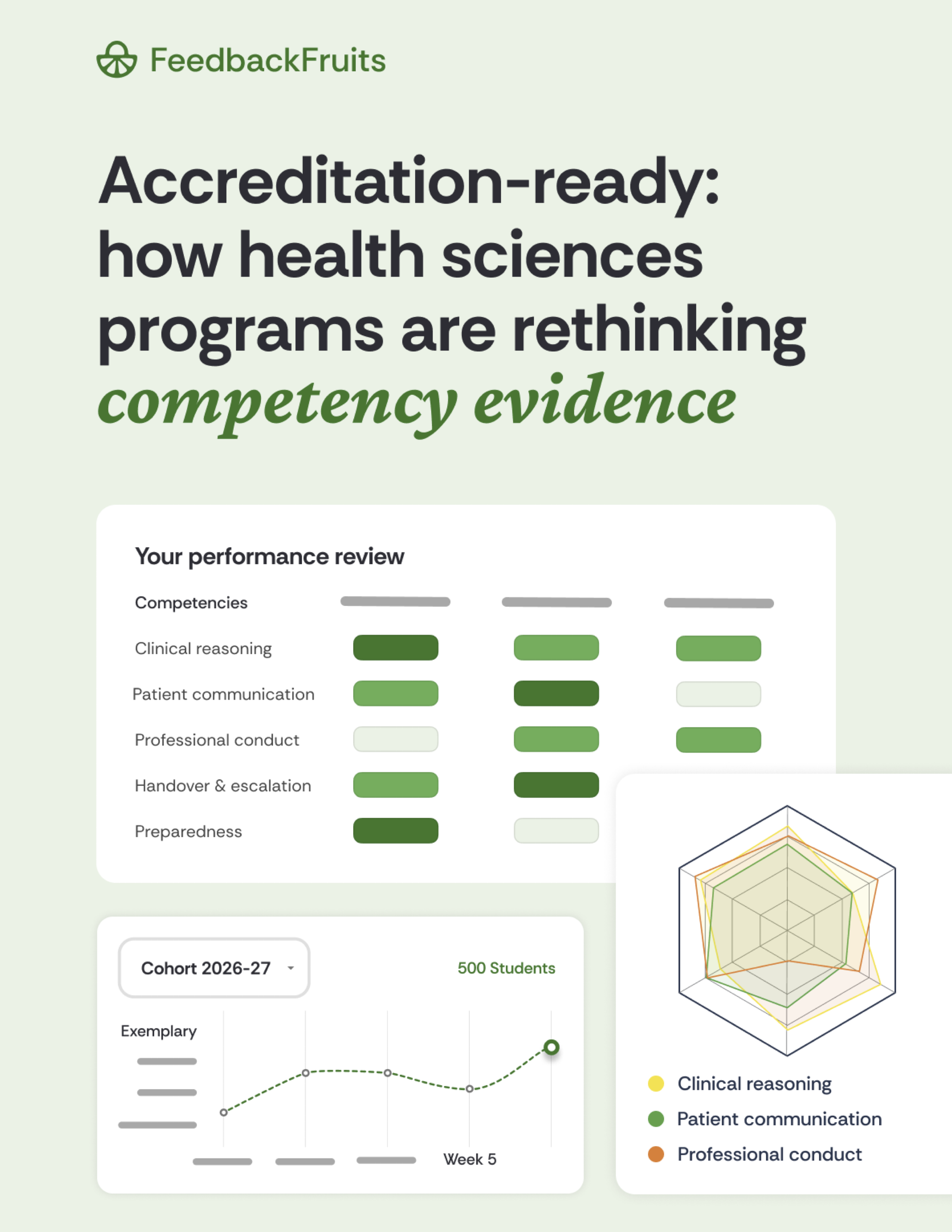
Competency-based assessment means something different depending on where you sit. For an accreditation coordinator, it's about producing evidence for a review cycle. For a clinical supervisor, it's about deciding whether a student is ready to practice without direct oversight. For a program director, it's about whether your infrastructure can generate the data you need at scale, consistently, without burning out faculty.
The challenge is building something that serves all three.
What separates competency-based assessment from traditional approaches
Competency-based assessment (CBA) evaluates learners on demonstrated mastery of specific competencies rather than time in a program or performance on a single exam. The defining features: criteria-referenced rather than norm-referenced; evidence gathered across multiple methods and settings over time; feedback that is formative and developmental; and a structure that supports defensible progression decisions. For a grounded overview, the FeedbackFruits beginner's guide to competency-based education and ebook on CBE are both useful starting points. For the regulatory picture specifically, the Accreditation-ready whitepaper maps what programs in the US, Canada, UK, and Australia are now required to produce.
Why adding more tests doesn't solve it
A common early misstep is treating CBA as a matter of increasing formal assessment events — more Objective Structured Clinical Examinations (OSCEs), more practical exams, more structured checkpoints. The logic seems sound: if you want to assess competence, test for it more.
The problem is that any single competency examination captures a snapshot. It tells you how a student performed that day, in that context. It says nothing about whether that performance reflects a stable, transferable skill or meaningful development over time.
The programmatic assessment framework developed by van der Vleuten and Schuwirth at Maastricht University, whose 2012 paper in Medical Teacher remains the foundational reference in health professions education makes this point rigorously: assessment validity should be evaluated at program level, not at the level of any individual instrument. This is precisely the logic built into current AACN and ACEN standards.
The methods that build a real evidence record
Direct observation is the cornerstone of clinical CBA. The ACGME has formalized this through its Milestones framework since 2013. The challenge is consistency: research has found that honors awards in surgery clerkships ranged from 5 to 67 percent across US medical schools with no standardized methodology. Rubrics with defined behavioral anchors are what convert observation from impressionistic to assessable. The FeedbackFruits rubric template library includes AACN Essentials-aligned rubrics programs can adapt directly, and the guide to rubrics is a practical reference for programs building or standardizing their own.
Peer review captures what supervisor observation can't — how students perform in collaborative reasoning, team handovers, and interprofessional settings. Texas A&M University School of Public Health implemented structured peer review across 3,000+ students without increasing administrative burden. The full case study is worth reading for the operational detail.
Reflective portfolios and self-assessment provide the longitudinal layer, evidence of how students understand and articulate their own development over time. The FeedbackFruits blog on the impact of self and peer grading on student learning goes deeper into the evidence base for this approach.
The clinical placement gap
The most significant structural blind spot in health sciences programs is clinical placements. Students spend hundreds of hours in supervised clinical environments where competencies are demonstrated constantly — but external supervisor feedback stays verbal, informal, and completely disconnected from any portfolio or accreditation report. The FeedbackFruits Feedback Request tool solves this directly: a student sends a criteria-aligned request to any external reviewer, the reviewer completes a mobile-friendly form with no login required, and the structured response flows automatically into the student's portfolio. For the design principles behind this, the FeedbackFruits blog on assessment and feedback challenges and opportunities is worth reading alongside the whitepaper.
What accreditation bodies are actually checking
The AACN requires programs to demonstrate individual student progression through ten competency domains with consistent, documented evidence across the full program. The ACEN requires institutions to show how assessment data informs program improvement — not just that it's been collected.
The Competency-Based Assessment for Medical Programs bundle brings all of this together inside your existing LMS — Skill Review, Peer Review, Group Member Evaluation, Feedback Request, and the CBA add-on all feeding into the same competency framework, producing the program-level dashboards and reports that AACN and ACEN require. Dr. Shay's webinar on implementing CBA in nursing education covers the full journey from fragmented rubrics to unified framework and is worth watching before designing your own approach.


![[New] Competency-Based Assessment](https://no-cache.hubspot.com/cta/default/3782716/interactive-146849337207.png)


.png)


.avif)


