The ultimate resources collection for faculty and student success

.png)


.avif)


.avif)



The impact of self and peer-grading on student learning
Besides receiving feedback only from teachers, relevant and effective feedback could also be provided by peers
.png)
The return of oral assessment, and why it's different this time
Learn how to design peer assessment that goes beyond grading to truly develop student thinking in the age of AI.
.png)
.png)
AI is changing learning: Are institutions keeping up or just keeping pace?
Most responses to AI with control, but we focus on pedagogy: learn how you can leverage our system to strengthen students' skills.
.png)
Ahead of the curve: how two European universities are rethinking online learning
Two European universities. Same goal. How Hertfordshire and the American College of Greece rethought online learning. Live panel, 5 May.

From isolated rubrics to a shared framework: How CDU is building a competency backbone
Learn how CDU unified assessments around AACN standards and how technology can turn learning activities into accreditation-ready evidence.

Scaling AI in higher ed: What institutional leaders are doing differently in 2026
Scaling AI, not just adopting it, is the real challenge: learn how institutions succeed by standardising trusted, high-impact workflows.

Community of Practice | Team Based Learning | Online edition 2026
Join our Community of Practice for a practical session of sharing, learning and connecting with peers around pedagogy.
.png)


FeedbackFruits in EIT HEI & European Universities Projects
Join us to know how to use pedagogical innovation as strategic infrastructure that supports governance, quality and measurable outcomes.
.png)
FeedbackFruits 2026 Pilot Programme: Live Q&A for Institutional Leaders
Live Q&A for institutional leaders on the 2026 Pilot Programme. Learn how to validate teaching innovation and scale with confidence.
.avif)


Advancing higher education in the Nordics: Exploring the Sikt, Instructure & FeedbackFruits partnership
Discover how Sikt, Instructure & FeedbackFruits’ new partnership empowers Nordic universities with pedagogy-driven learning in Canvas.

Scaling effective peer review: A collaboration with Durham University and Jisc
Join FeedbackFruits, Jisc, and Durham University for a webinar exploring innovative peer review approaches in higher education.
.png)
.png)
Education for all: Inclusive pedagogy that builds belonging, equity and engagement
Explore how designing for student variability supports equity, belonging, and engagement through flexible, intentional course design.

Building the future of learning design: 2025 updates with FeedbackFruits
Meet FeedbackFruits’ new Learning Design System and Studio, bringing modularity, AI, and seamless LMS integration together.


Future-proofing higher ed: Soft skills & project/problem-based learning for career readiness
Discover how to implement project-based learning and soft skills development to foster career readiness

Enhance collaborative learning in your LMS: Insights from a SUNY success story
Learn how FeedbackFruits help a SUNY institution transform its LMS into a collaborative, interactive learning space

Efficiency vs. Quality: Are We Sacrificing Learning for Automation with AI?
This panel discussion will explore the ethical, practical, and pedagogical implications of using AI in assessment and grading.


Putting Students at the Center: Active Learning Strategies at John Brown University
Explore how John Brown University ensured student-centered learning with active learning strategies


How to individualize group project grades in a transparent, reasonable, and responsible way
Learn how to individualize group project grades in a transparent, reasonable, and responsible way

Including the Future: Changing Course Culture by Including Students in the Syllabus
This session explores how to recenter the course environment to prioritize human interactions by prioritizing student participation



Making group work "work": Scaling collaboration and feedback for active learning at Yale University
Learn how Yale University piloted FeedbackFruits to scale group and peer-to-peer feedback opportunities.

Employability Fundamentals: Incorporating Professional Development into Academic Curricula
Explore how Quest Education Group enhances career readiness through innovative teaching approaches


Innovating for Scalable Student Engagement and Success at University of Free State
Join the University of Free State University team to discover how to transform teaching & learning with FeedbackFruits


%20(1).avif)
Unlock the power of group work: Make peer-to-peer learning easy to organize
Discover how to facilitate successful group work! Join our webinar to learn best strategies for better collaboration and student engagement.

Generative AI in Higher Ed: Rethinking Learning strategies for Business Schools
Join us and panelists from HEC, ESSEC & EDHEC on April 25th to discover the potential impact of GenAI on higher education

Empowering Career Readiness: AI-Driven Strategies for Community Colleges
Join us and Santa Ana College on March 27th to discover how community colleges can harness the power of AI to nurture career readiness

AI-Driven Transformation: Personalizing Online and Hybrid Learning for Student Success
Join us and the University of Akron on March 6th to discover AI-driven strategies for enhancing online and hybrid learning

Personalizing Growth: Shifting to Competency-Based Education with FeedbackFruits
Join us and RSM on November 30th to discover how to drive an smooth transition to Competency-Based Education with FeedbackFruits

Developing Lifelong Skills with Active Learning Design
Join us and TAMU on October 18th to discover best course design strategies to implement active learning for skill development

Nurturing student satisfaction through personalised assessment and feedback
Join us, Imperial College London, and the University of Bath on October 12th to discover best strategies for student-centred assessment

Enhancing the learning and assessment experience with FeedbackFruits
Join us on August 23rd to discover how to innovate assessment and feedback for a better student experience with FeedbackFruits


.avif)


Engagement That Lasts: Best Strategies for Inclusive Course Design
Join us on February 17th to discover the best strategies for ensuring continuous engagement and participation
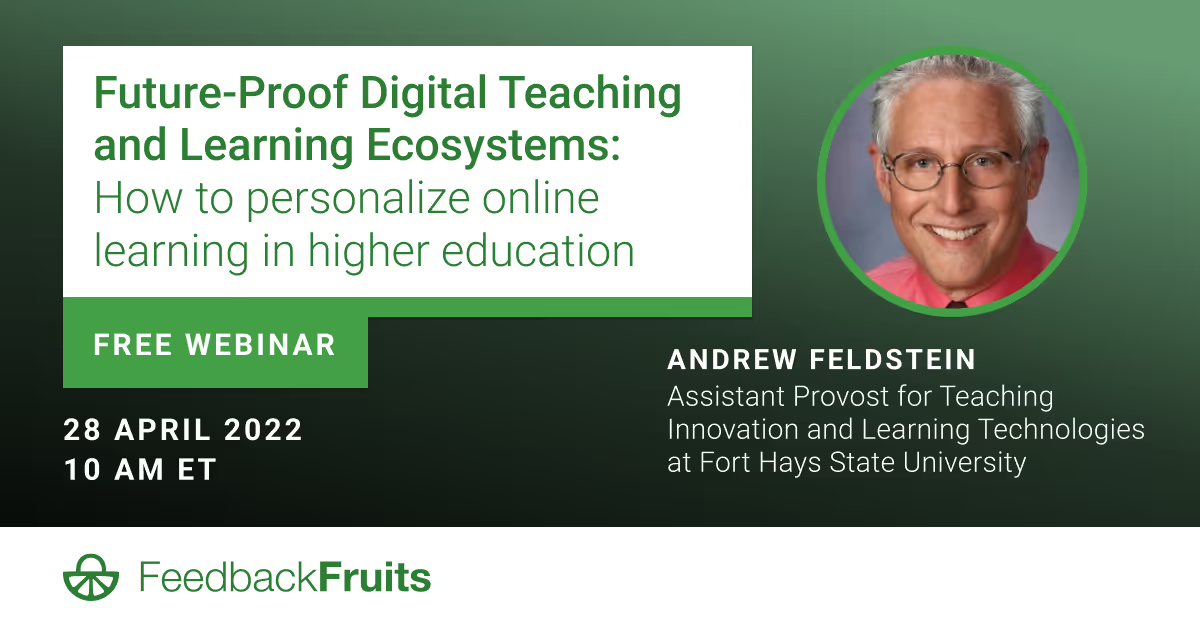
Future-Proof Digital Teaching and Learning Ecosystems: How to personalize online learning in higher education
Join us on April 28th to discover the best long-term strategies for cultivating personalized learning in Blackboard with Andrew Feldstein

Formative assessment
Formative assessment transforms learning into a journey of empowering growth, where timely feedback and reflection inspire students to reach their fullest potential.
Socratic method
Engage students in critical dialogue and deep inquiry to challenge assumptions, explore ethical dilemmas, and refine their understanding of privacy and surveillance in Marketing through the Socratic method.
Constructivist pedagogy
Help learners become active participants who build knowledge by discovering, transforming, and integrating information rather than passively consuming it.



Transformative learning
Equip your students with the tools to critically examine their worldview, habitual behaviors, and cognitive biases, fostering conscious, open-minded, and empathetic lifelong learners.

Social-emotional learning
Help your students thrive and shape a more just, responsible, and compassionate society by strengthening their emotional intelligence, self-awareness, and interpersonal skills.
Humanistic pedagogy
Foster student agency, personal growth, and deeper engagement by centering learning around individual experiences, self-reflection, and intrinsic motivation—empowering students to take ownership of their education.


Applied soft skills
Bridge the gap between theory and practice—equip students with essential soft skills through immersive, hands-on experiences to drive professional success.

Experiential learning
Transform learning into action—immerse students in authentic, hands-on experiences that foster critical thinking, adaptability, and deeper knowledge application, preparing them to navigate complex real-world challenges with confidence.


Inquiry based learning
Inquiry-based learning turns curiosity into deep learning by enabling students to explore, innovate, and solve problems, fostering critical thinking, collaboration, and lifelong learning.

Culturally responsive teaching
Culturally responsive teaching (CRT) acknowledges and values students' diverse cultural backgrounds by incorporating cultural references into learning experiences and fosters inclusivity.

Competency-based learning
CBE ensures that students master essential skills and competencies at their own pace focusing on demonstrated proficiency rather than seat time, fostering learning and real-world readiness.


.png)
Beyond the first AI answer: compare, verify, and explain
A template where students use three different generative AI tools to summarise the same assigned reading or scholarly source and critically compare the outputs for accuracy, completeness, and reliability. Students then create their own evidence-based explainer of a key concept from the article, which peers review using structured criteria.
Team-based asynchronous critique of live presentations
A template for courses where teams present live in class and peers provide structured critique using a shared rubric. Remaining teams who did not critique live can participate asynchronously through FeedbackFruits, ensuring all students engage with the feedback process regardless of their role on the day.
Enhancing AI Literacy: handling AI bias, hallucinations, and cognitive offloading
Template using interactive document to help students reflect on their use of generative AI and develop the metacognitive skills needed to integrate it effectively, covering key topics including AI bias, hallucinations, and cognitive offloading.
Explain & Assess: peer review of mathematical reasoning videos
A template for assessing mathematical reasoning through short video explanations, where students verbalise their thinking, give structured peer feedback on each other's videos, and receive instructor feedback on the quality of the feedback they provided.
.avif)
Glow and grow: Feedback on oral presentations
Template to help students provide structured peer feedback on oral presentation delivery during a mock run, supporting the development of presentation skills and self-regulatory learning before a final assessment.
Group member evaluation of teamwork and communication skills
Template to help students assess and provide structured feedback on each other's communication and collaboration skills throughout a group project, supporting the development of real-world teamwork and conflict resolution skills.
Peer review of data visualisation report designs
Template to help student groups critically evaluate peer-created data visualisation reports, providing structured, evidence-based feedback on visual design choices, data encoding, and adherence to key data visualisation principles.
Final group member evaluation for group project
Template to help students provide a final assessment of individual group member contributions at the close of a group project, using a structured rubric to evaluate and give feedback on each member's performance throughout.
Peer review of student designed learning games
Template to help students critically evaluate peer-designed learning games through structured gameplay experience, providing evidence-based feedback on game design, learning effectiveness, and overall player experience.
Peer feedback and self reflection on collaboration skills
A template for developing feedback literacy: students give peer feedback on group collaboration, then receive, reflect on, and respond to the feedback they get in return - all in one activity using the Learning Design Studio.

Exploring red flag legal issues through podcast and peer discussion
Template designed to engage students in reflecting on real-world legal “red flag” issues by recording a podcast and participating in peer discussions to connect theory with professional experience.
Exploring real-world teaching scenarios through social annotation
Template for an interactive social annotation activity where students analyze teaching scenarios, give rubric-guided comments, and reflect to plan actionable teaching improvements.
Clarity through feedback: A physics peer review workshop
Template designed to help students develop critical writing and argumentation skills through peer review, encouraging evidence-based reasoning and professional, reflective feedback.
Developing critical writing skills through peer review and reflection
Template designed to help students develop critical writing and argumentation skills through peer review, encouraging evidence-based reasoning and professional, reflective feedback.
Exploring active and technology enhanced learning through interactive document
Template to help students reflect on and improve their teaching by advising a hypothetical colleague, using interactive questions to explore active learning and technology-enhanced instruction.
Self-assessment of values, learning, and skills for future career decisions
Template designed to help students reflect on their values, learning experiences, and skills, encouraging self-awareness and guiding thoughtful future career and professional decision-making.
Analyzing leadership and emotional intelligence through social annotation
Template designed for students to explore leadership and emotional intelligence by annotating key moments in a video and reflecting on connections to theory and personal practice.
Strengthening research quality through structured peer feedback
Template designed to guide teams in exchanging structured peer feedback on preliminary research, fostering cross-team learning, refining analysis, and strengthening strategies through diverse perspectives.
Self-reflection: Connecting learning to personal growth
Template designed to help students reflect on their learning journey, evaluate growth through feedback, and apply humanistic learning principles to future learning and professional contexts.
Challenging cognitive biases through reflection and peer feedback
Template designed to help students reflect on a classroom discussion, then engage in a structured peer review, giving and receiving constructive feedback on the first draft of essays related to the discussion.


Featured resources
Oral Assessment at Scale
.png)

Ebooks and guides
.avif)

Webinars

Pedagogy Guides

Templates
Beyond the first AI answer: compare, verify, and explain
A template where students use three different generative AI tools to summarise the same assigned reading or scholarly source and critically compare the outputs for accuracy, completeness, and reliability. Students then create their own evidence-based explainer of a key concept from the article, which peers review using structured criteria.
Team-based asynchronous critique of live presentations
A template for courses where teams present live in class and peers provide structured critique using a shared rubric. Remaining teams who did not critique live can participate asynchronously through FeedbackFruits, ensuring all students engage with the feedback process regardless of their role on the day.
Enhancing AI Literacy: handling AI bias, hallucinations, and cognitive offloading
Template using interactive document to help students reflect on their use of generative AI and develop the metacognitive skills needed to integrate it effectively, covering key topics including AI bias, hallucinations, and cognitive offloading.

Blogs

.avif)
Subscribe to our teaching insights newsletter